Choosing a preschool isn’t just about finding a good school. It’s about finding the right learning environment for your child.
As parents compare preschool options, two approaches often come up: Montessori and play-based preschool. Both can provide nurturing environments where young children learn, explore, build friendships, and develop important skills. But the way children spend their day—and how teachers guide their learning—can look quite different.
So, how do you know whether Montessori or a play-based preschool is right for your child?
The answer often comes down to how your child learns, what motivates them, and what you want them to gain from their preschool experience.
What Is the Difference Between Montessori and Play-Based Preschool?
A play-based preschool generally uses open-ended play as a primary way for children to learn. Children may spend time with pretend kitchens, dress-up areas, blocks, sensory activities, art projects, music, outdoor play, and teacher-planned activities.
Through play, children can practice communication, creativity, problem-solving, cooperation, and other developmental skills.
A Montessori preschool is also hands-on and child-centered, but the environment is more intentionally structured around specific developmental and educational materials.
Children have choices about what they work on, but those choices occur within a carefully prepared classroom. Montessori teachers introduce materials and lessons, observe each child’s progress, and guide children toward increasingly challenging work as they become ready.
The difference isn’t simply play versus academics.
It’s largely about how the child’s exploration is structured and how learning progresses.
Does Your Child Like to Do Things Independently?
Some young children reach a stage where their favorite phrase seems to be, “I can do it myself.”
If that sounds familiar, Montessori may be worth exploring.
Independence is an important part of the Montessori approach. Classrooms are intentionally designed to allow children to accomplish age-appropriate tasks on their own.
Children learn to select materials, complete activities, return materials to their proper places, care for their environment, and gradually take greater responsibility for themselves.
But your child doesn’t need to already be highly independent to benefit from Montessori.
Learning to become independent is part of the Montessori experience.
Children receive guidance and support from their teachers while gradually developing the confidence and skills to do more for themselves.
Does Your Child Thrive With Routine and an Organized Environment?
Take a look around a Montessori classroom and you’ll usually notice something immediately: everything has a place and a purpose.
Materials are organized on accessible shelves. Children learn how to choose an activity, use it appropriately, complete their work, and return it for the next person.
For children who respond well to consistency and predictable expectations, this type of environment can be very appealing.
There is freedom, but that freedom exists within structure.
A play-based classroom can also have routines, of course, but the learning environment may include more open-ended activity centers and imaginative spaces.
If your child enjoys knowing what to expect and takes satisfaction in completing tasks, Montessori may be a particularly good fit.
Is Your Child Drawn to Pretend Play?
If your child’s favorite activity is creating elaborate imaginary worlds, dressing up as different characters, or turning the living room into a grocery store, restaurant, or spaceship, this is something to consider when comparing schools.
Many play-based programs make dramatic and imaginative play a central part of the classroom experience.
Traditional Montessori early childhood environments tend to place greater emphasis on purposeful activities connected to the real world.
That doesn’t mean Montessori discourages creativity or imagination. Children have opportunities for art, music, language, movement, exploration, and creative thinking. However, fantasy-based dramatic play is typically not the central organizing feature of a Montessori classroom.
Neither approach is inherently better.
The question is which environment most closely matches what you’re looking for in your child’s preschool experience.
Does Your Child Love Hands-On Activities?
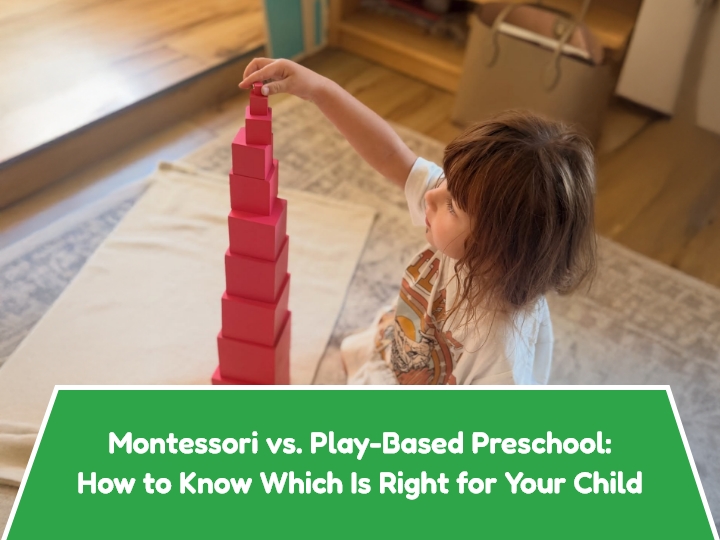
Montessori can be especially engaging for children who want to touch, move, sort, build, pour, count, arrange, match, and figure things out for themselves.
Montessori materials are designed to make learning concrete.
Rather than simply hearing an adult explain a concept, children often interact physically with materials that demonstrate it.
This is especially noticeable in areas such as mathematics, language, practical life, and sensorial development.
To a young child, these activities can be highly enjoyable. But they also have an intentional developmental or educational purpose.
Does Your Child Like Repeating an Activity Until They Master It?
Have you ever watched your child complete the same puzzle over and over again or practice a new skill long after you thought they would lose interest?
Young children often learn through repetition.
Montessori gives children opportunities to repeat activities without having to move on simply because the rest of the class is moving to something different.
That repetition can help develop concentration, coordination, confidence, and mastery.
If your child becomes deeply focused on an activity and enjoys the satisfaction of mastering it, the Montessori work cycle may be a good match.
Would Your Child Benefit From Learning at Their Own Pace?
This is one of the biggest reasons some families choose Montessori.
Children don’t all develop at exactly the same pace—and they aren’t necessarily at the same level in every area.
A child might be advanced in language while needing more time with mathematics. Another might understand numbers quickly while still developing fine motor skills or concentration.
Montessori allows teachers to respond to those differences.
A child who needs more practice can spend additional time developing a skill. A child who demonstrates mastery can be introduced to something more challenging.
Self-paced doesn’t mean children are left on their own.
Montessori teachers observe children’s progress, introduce lessons, provide guidance, and help ensure children continue moving forward.
Is Your Child Ahead in Certain Areas?
Parents of advanced learners sometimes worry that preschool won’t provide enough challenge.
An individualized Montessori environment can be especially interesting for these families because children aren’t necessarily restricted to what the entire class is learning.
If a child is ready to move forward, the teacher can introduce more advanced materials.
Instead of asking only, “What should a four-year-old be learning?” Montessori allows the teacher to consider, “What is this child ready to learn next?”
That can help children remain curious and appropriately challenged.
What If Your Child Needs More Time?
The same individualized approach can benefit a child who needs additional time.
In a Montessori classroom, needing repetition doesn’t automatically mean a child is “behind.”
A teacher can observe where the child is having difficulty, provide additional lessons, encourage practice, and give the child opportunities to strengthen foundational skills.
The goal isn’t to make every child reach every milestone on exactly the same day.
The goal is to help each child continue progressing from where they are.
Are You Concerned About Kindergarten Readiness?
For many parents, preschool isn’t only about what happens today. They’re also thinking about what happens next.
Will my child be ready for kindergarten?
Will they understand early math and language concepts?
Will they be able to follow directions?
Will they be able to work independently?
Montessori supports academic development alongside practical, social, and emotional skills.
Children can develop early language and mathematical understanding while also practicing concentration, independence, problem-solving, communication, responsibility, and care for their classroom environment.
The emphasis is not simply on completing an activity.
It is on understanding, practicing, and eventually mastering skills.
Is Socialization Important to You?
Social development is an important part of both Montessori and play-based preschool, although it may happen differently.
In play-based classrooms, children may socialize extensively through pretend scenarios, collaborative games, activity centers, and group play.
Montessori children also interact throughout the day, but the classroom places significant emphasis on learning how to function respectfully within a community.
Children practice waiting, communicating, respecting another child’s work, caring for shared materials, resolving everyday conflicts, and demonstrating grace and courtesy.
Montessori classrooms also traditionally include mixed-age groups within a developmental range.
Younger children can learn by observing older classmates, while older children have opportunities to develop confidence and leadership.
Your Child May Thrive in a Montessori Preschool If…
Montessori may be worth considering if your child:
- Enjoys hands-on exploration
- Likes accomplishing things independently
- Becomes deeply focused on activities that interest them
- Enjoys repetition and mastering new skills
- Responds well to routine and an organized environment
- Would benefit from learning at an individual pace
- Needs additional academic challenge
- Needs additional time in certain developmental areas
- Enjoys real-world, purposeful activities
- Is curious about how things work
You may also prefer Montessori because you want your child to develop these qualities, even if they aren’t showing all of them yet.
A child doesn’t have to arrive at preschool already independent, focused, organized, or confident. Montessori is designed to help nurture those abilities.
Your Child May Prefer a Play-Based Preschool If…
A play-based environment may appeal to families looking for a preschool experience centered heavily around:
- Open-ended imaginative play
- Dramatic play and dress-up
- Pretend scenarios
- Frequently changing themed activities
- Large amounts of collaborative free play
- Teacher-created creative experiences
There is significant variation among play-based preschools, just as there can be variation among schools using the Montessori name.
That’s why the best way to compare the two isn’t simply by reading their websites.
Visit the classrooms.
How Can You Tell Which Preschool Is Right for Your Child?
When touring a preschool, don’t focus only on whether you personally like the classroom.
Try to picture your child in it.
Would your child know what to do?
Do the children appear engaged?
Are they able to concentrate without constant adult direction?
How do teachers respond when a child struggles?
What happens when a child masters something quickly?
How is independence encouraged?
How is progress monitored?
How much of the day is child-directed versus teacher-directed?
What does kindergarten readiness look like at the school?
And perhaps most importantly:
Can you picture your child becoming more confident, capable, curious, and excited about learning here?
The answers can tell you much more than the label “Montessori” or “play-based.”
See Whether Montessori Is Right for Your Child
You can read about Montessori philosophy, but it is much easier to understand once you see a Montessori classroom in action.
Cave Creek Montessori serves children from 18 months through kindergarten in an authentic, culturally rich Montessori environment. For more than 25 years, our family-run school has helped children build independence, confidence, academic readiness, and a lifelong love of learning.
We serve families throughout Cave Creek, Carefree, North Scottsdale, North Phoenix, Desert Ridge, and surrounding communities.
If you’re comparing Montessori and play-based preschool, schedule a tour of Cave Creek Montessori. Meet our teachers, see the classroom environment, and discover whether Montessori feels like the right fit for your child.
Frequently Asked Questions About Montessori vs. Play-Based Preschool
What is the main difference between Montessori and play-based preschool?
Both approaches can provide hands-on learning experiences, but Montessori uses a carefully prepared environment with purposeful materials designed to develop particular skills. Play-based preschool generally relies more heavily on open-ended, imaginative, and dramatic play as a way for children to learn.
How do I know if Montessori is right for my child?
Children who enjoy hands-on activities, independence, repetition, concentration, routine, and mastering new skills may respond especially well to Montessori. However, children don’t need to already possess these qualities. A Montessori environment is designed to help children develop greater independence, concentration, confidence, and responsibility.
Is Montessori too structured for creative children?
Montessori combines freedom with structure. Children make choices and explore their interests within a prepared environment. Creativity can be expressed through art, language, music, movement, problem-solving, and exploration, although fantasy-based dramatic play is typically less central than it is in many play-based programs.
Is Montessori or play-based preschool better for kindergarten readiness?
Both approaches can support school readiness. Montessori specifically incorporates hands-on language, mathematics, practical life, and sensorial activities while also developing independence, concentration, responsibility, and problem-solving skills that can help prepare children for kindergarten.
Is Montessori good for children who aren’t independent yet?
Yes. A child does not need to be independent before starting Montessori. Developing independence is an important part of the Montessori approach, and teachers gradually help children learn to complete appropriate tasks and make choices for themselves.
Is Montessori good for gifted or advanced children?
Montessori’s individualized approach can benefit advanced learners because children can progress to more challenging materials when they demonstrate readiness rather than always moving at the same pace as an entire class.
What if my child needs more time to learn?
Montessori allows children to repeat activities and strengthen foundational skills before moving forward. Teachers observe progress and can provide additional instruction and practice when a child needs more time.
Should I tour both Montessori and play-based preschools?
Yes. A tour allows you to see how each philosophy is actually implemented. Observe the classroom, teachers, children, learning materials, routines, and interactions. Ask how teachers monitor progress, support children who struggle, challenge advanced learners, and prepare children for kindergarten.