One of the most common concerns parents have when considering Montessori education is simple: If children are allowed to learn at their own pace, what keeps them from falling behind?
It is an understandable question, especially for parents who are used to traditional classrooms where every child is expected to work on the same lesson at approximately the same time.
But self-paced learning in Montessori does not mean children are left to decide whether or not they learn important skills. Montessori education is individualized, carefully observed, and intentionally guided by trained teachers. Children have freedom within a structured environment, and teachers continually monitor their development to make sure they are progressing academically, socially, emotionally, and developmentally.
Self-Paced Does Not Mean “Learn Whatever You Want”
A Montessori classroom gives children choices, but those choices exist within a thoughtfully prepared learning environment.
Teachers introduce lessons and materials based on each child’s readiness and development. As children master skills, they are introduced to increasingly challenging work.
Instead of saying, “Every four-year-old must complete this exact worksheet today,” the Montessori approach asks, “What is this child ready to learn next?”
That allows a child who quickly understands a concept to continue moving forward rather than waiting for the rest of the class. At the same time, a child who needs additional practice can spend more time building a strong foundation before advancing.
The goal isn’t to move every child at exactly the same speed. The goal is to help every child continue moving forward.
Montessori Teachers Closely Observe Each Child’s Progress
Montessori teachers do much more than simply watch children choose activities.
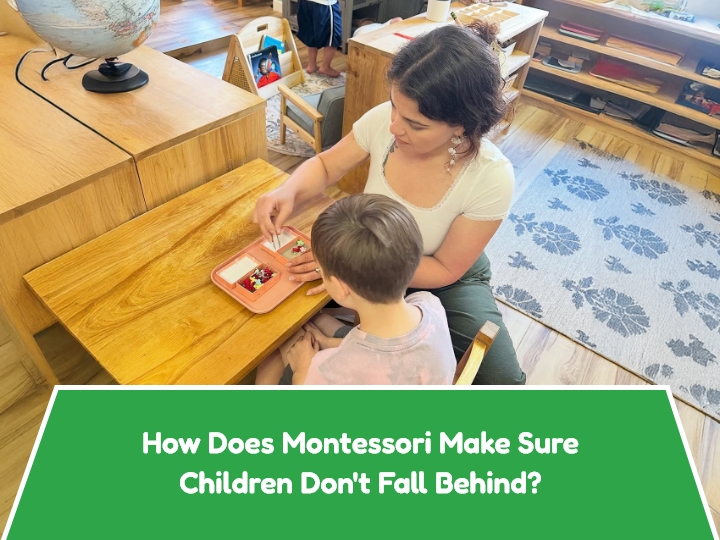
Observation is an important part of the Montessori method. Teachers pay attention to what children are working on, which skills they have mastered, where they may be struggling, and when they are ready to be introduced to something new.
This gives teachers the opportunity to recognize gaps early.
If a child repeatedly avoids a particular type of work or is having difficulty mastering an important skill, the teacher can provide additional lessons, introduce the concept differently, or guide the child toward activities that strengthen the underlying skills.
Rather than waiting for a test to reveal that a child has been struggling for months, Montessori teachers have opportunities to identify challenges through ongoing observation and interaction.
Children Build Skills in a Logical Progression
Montessori materials are intentionally designed to build upon one another.
Children generally progress from concrete, hands-on experiences toward more abstract concepts. This is especially valuable in areas such as mathematics and language.
For example, rather than simply memorizing an abstract mathematical rule, a child may first work with physical Montessori materials that allow them to see and manipulate quantities. As understanding develops, the child gradually moves toward more abstract mathematical thinking.
This progression helps teachers see whether a child understands the foundation necessary for the next skill.
Instead of pushing a child ahead simply because the calendar says it is time for the next unit, Montessori allows the child to develop genuine understanding.
Teachers Can Provide More Challenge When a Child Is Ready
Parents sometimes worry about children falling behind, but there is another side to individualized learning: What happens when a child is ready to move ahead?
In a traditional classroom, a child who masters a concept quickly may still need to wait while the class completes the same unit.
Montessori allows teachers to introduce more advanced work when the individual child demonstrates readiness.
This can be particularly beneficial for advanced learners and children who become deeply interested in a subject. Rather than limiting learning according to age or a predetermined classroom pace, teachers can continue providing appropriate challenges.
The result is an environment designed to meet children where they are—whether they need additional time, additional practice, or additional challenge.
Repetition Helps Children Develop Mastery
Montessori places significant value on repetition.
Young children often enjoy repeating an activity many times, and Montessori recognizes that repetition can be an important part of learning. Each time children repeat meaningful work, they can strengthen their understanding, coordination, concentration, and confidence.
A child isn’t necessarily “behind” because they need more repetition.
Sometimes that additional time is exactly what allows a concept to become secure enough for the child to successfully tackle more difficult work later.
Building a strong foundation can be more valuable than rushing through skills simply to keep up with a predetermined schedule.
Independence Doesn’t Mean Learning Without Support
Another misconception is that Montessori independence means children are expected to figure everything out on their own.
They aren’t.
Montessori teachers actively guide children while gradually helping them become more capable and independent learners.
Teachers demonstrate materials, introduce lessons, redirect when appropriate, observe progress, and help children choose work that supports their development.
Over time, children learn something especially valuable: how to take an active role in their own learning.
They practice making choices, completing tasks, solving problems, managing frustration, caring for their environment, and returning to challenging work.
These habits can help prepare children not only academically but also for the increasing independence expected in kindergarten and elementary school.
What If My Child Avoids Something They Find Difficult?
This is often the question underneath the question about falling behind.
Parents may think, “If my child doesn’t like math, couldn’t they simply choose something else every day?”
A Montessori classroom is not designed to work that way.
Teachers observe children’s choices and patterns. If a child consistently avoids an area of the classroom or a skill that needs development, the teacher can intervene and provide guidance.
The approach may be different from forcing an entire class through the same assignment, but the teacher is still responsible for guiding the child’s educational development.
Freedom in Montessori exists within appropriate limits and expectations.
Does Montessori Prepare Children for Kindergarten?
Montessori education is designed to support the whole child, including the academic, social, emotional, and practical skills that contribute to school readiness.
Children have opportunities to develop language and early literacy skills, mathematical understanding, concentration, fine motor coordination, problem-solving, independence, communication, and the ability to work within a classroom community.
Just as importantly, children can develop confidence in themselves as learners.
Rather than simply asking, “Can my child complete this worksheet?” Montessori encourages a broader question:
Does my child understand the concept, and are they ready to apply it independently?
That focus on understanding and mastery can create a strong foundation for future learning.
Montessori Meets Children Where They Are—Then Helps Them Move Forward
Children do not all develop at exactly the same rate.
One child may be advanced in language but need more time with mathematics. Another may grasp academic concepts quickly while still developing concentration or fine motor skills.
Montessori recognizes these differences without lowering expectations.
Instead, teachers observe the whole child and provide lessons, materials, repetition, and challenges based on individual readiness.
The objective is not for every child to be in exactly the same place on exactly the same day.
The objective is consistent growth, meaningful understanding, and preparation for what comes next.
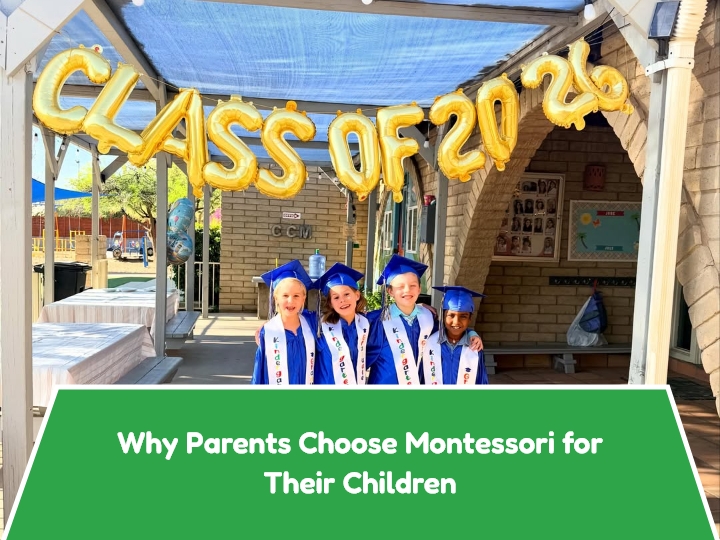
See Montessori Learning in Action at Cave Creek Montessori
If you’re wondering whether Montessori will provide enough structure or academic challenge for your child, one of the best ways to understand the approach is to see a Montessori classroom for yourself.
Cave Creek Montessori serves children from 18 months through kindergarten, providing an authentic Montessori environment where children can build independence, confidence, academic readiness, and a lifelong love of learning.
For more than 25 years, our family-run school has served families throughout Cave Creek, Carefree, North Phoenix, North Scottsdale, Desert Ridge, and surrounding communities.
Schedule a tour of Cave Creek Montessori to see how individualized Montessori learning can support your child’s development while making sure they continue to grow, progress, and be appropriately challenged.
Frequently Asked Questions About Falling Behind in Montessori
Can children fall behind in Montessori?
Montessori is designed around ongoing teacher observation and individualized instruction. Teachers monitor children’s development, introduce lessons based on readiness, and provide additional support or challenge when needed. Self-paced learning does not mean children are left without educational guidance.
If Montessori is self-paced, can my child just avoid subjects they don’t like?
No. Children have meaningful choices within a structured classroom environment, but teachers observe those choices. If a child consistently avoids an important area of learning, the teacher can guide the child toward appropriate activities and provide additional instruction.
How do Montessori teachers know if a child is struggling?
Teachers closely observe children’s daily work, including the materials they choose, skills they have mastered, areas they avoid, and concepts that require additional practice. This ongoing observation helps teachers determine when a child needs more support or a different approach.
Is Montessori academically challenging enough?
Montessori can provide significant academic challenge because children are not necessarily limited to the pace of an entire class. When a child demonstrates mastery and readiness, the teacher can introduce more advanced materials and concepts.
Is Montessori good for gifted or advanced children?
The individualized nature of Montessori can be beneficial for advanced learners because children may continue progressing when they are ready rather than waiting for classmates to reach the same point. Teachers can introduce increasingly challenging work based on the individual child’s readiness.
What happens if my child needs more time to learn a skill?
Montessori allows children to repeat meaningful activities and strengthen foundational skills before progressing. Needing additional practice is not treated as failure. The teacher can provide support while allowing the child the time necessary to develop genuine understanding and confidence.
Will my Montessori child be ready for a traditional kindergarten or elementary school?
Montessori helps children develop academic foundations along with independence, concentration, problem-solving, communication, and classroom responsibility. These skills can support children as they transition into different educational environments.
How does Montessori balance freedom with structure?
Montessori offers freedom within limits. Children have choices about their work, but those choices occur within a carefully prepared environment with teacher guidance, classroom expectations, and developmentally appropriate learning goals.