Every child develops at their own pace. Some children are reading before kindergarten. Others need more repetition, reassurance, and time to build confidence. In many traditional classrooms, children are expected to move through lessons at the same speed, regardless of readiness. This can leave advanced learners bored and children who need more time feeling discouraged.
Montessori education is intentionally designed to meet both types of learners — and every child in between.
At a Montessori preschool, learning is not one-size-fits-all. It is personalized, flexible, and responsive to each child’s developmental stage.
The Montessori Philosophy: Follow the Child
One of the core principles of Montessori education is “follow the child.” This means teachers carefully observe each student to understand their interests, strengths, and readiness for new challenges. Instead of pushing every child through the same lesson plan at the same time, Montessori guides introduce materials individually when a child is developmentally prepared.
If a child shows early interest in numbers, they may be introduced to advanced math materials sooner. If another child is still mastering fine motor skills, the teacher provides activities that strengthen those foundational abilities before moving forward.
This respectful approach prevents frustration and builds genuine confidence.
How Montessori Supports Advanced Learners
In traditional settings, advanced learners may finish work quickly and then wait for the rest of the class to catch up. Over time, this can lead to boredom or disengagement.
Montessori classrooms eliminate this ceiling.
Because lessons are presented individually, a child who masters a concept can immediately move to the next level of material. There is always a deeper layer to explore — whether in math, language, science, or cultural studies.
For example:
- A child who quickly grasps counting may progress to golden bead materials and begin working with larger numbers.
- A preschooler who starts reading early can move into phonetic reading, grammar symbols, and sentence construction.
- A curious learner interested in geography may explore puzzle maps, landforms, and cultural studies far beyond basic exposure.
The mixed-age classroom also plays an important role. Younger children are inspired by older classmates working on advanced materials, and older students reinforce their knowledge by mentoring younger peers. This dynamic supports leadership, empathy, and mastery.
In Montessori, advanced learners are not held back — they are continually challenged in meaningful ways.
How Montessori Supports Children Who Need More Time
Equally important, Montessori protects children who need additional time to develop certain skills.
In a traditional classroom, a child who struggles may feel pressure to “keep up.” In Montessori, there is no comparison chart on the wall and no race to finish worksheets. Progress is individualized and private.
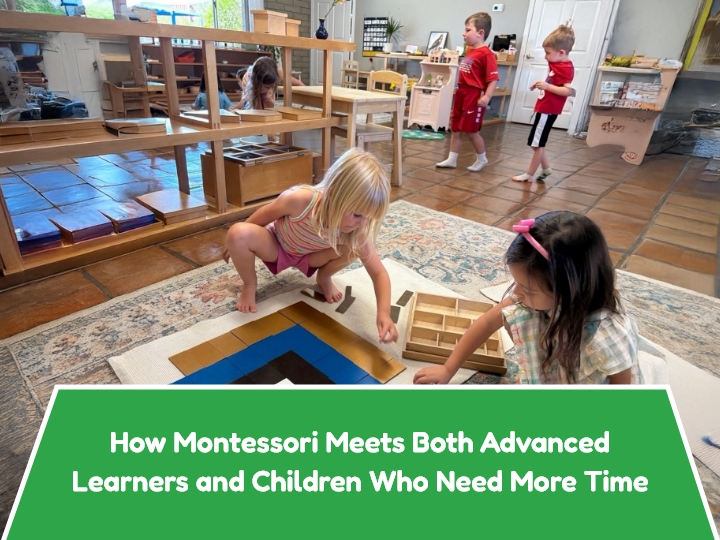
Children repeat activities as often as needed. Repetition is encouraged because it builds neural pathways and deep understanding. A child might work with practical life materials — pouring, spooning, transferring — for weeks, strengthening coordination and concentration before moving on to more abstract tasks.
Teachers provide gentle guidance, modeling lessons again when necessary, but they avoid rushing the child forward before true readiness is achieved.
This reduces anxiety and fosters resilience.
Children who once seemed hesitant often flourish in a Montessori environment because they are given the gift of time.
The Power of Mixed-Age Classrooms
One of the most misunderstood but powerful elements of Montessori education is the mixed-age classroom.
This structure naturally supports personalization.
Younger children learn by observing older peers. Older children gain confidence and mastery by helping younger classmates. Because there is always a range of abilities in the room, no child feels labeled as “ahead” or “behind.” Each child is simply progressing along their own path.
The classroom environment itself is carefully prepared with materials that move from concrete to abstract and from simple to complex. Children choose work that matches their readiness, guided by trained Montessori teachers who ensure steady growth.
Building Confidence for Life
When children are allowed to move at their own pace, something powerful happens. Advanced learners remain curious and engaged. Children who need more time develop competence without shame. Both groups build independence, concentration, and intrinsic motivation.
Rather than teaching children to compete, Montessori teaches them to grow.
Over time, this personalized approach creates learners who are self-directed, confident, and capable of tackling new challenges — not because they were pushed, but because they were ready.
Discover Personalized Montessori Learning in Action
If you are looking for a preschool where your child will be seen, understood, and guided according to their unique strengths and needs, we invite you to visit Cave Creek Montessori.
Schedule a tour to experience how individualized Montessori education supports both advanced learners and children who simply need more time to thrive. We would love to show you how your child’s journey can unfold in a carefully prepared, nurturing environment.
Frequently Asked Questions
Does Montessori work for advanced learners?
Yes. Montessori is well suited for advanced learners because children are not limited by a fixed curriculum or pace. When a child masters a concept, teachers introduce more challenging lessons, allowing them to continue growing academically while maintaining a love of learning.
What if my child needs more time to learn?
Montessori recognizes that every child develops at their own pace. Children who need additional time receive individualized guidance and opportunities to practice until they achieve mastery, helping them build confidence without the pressure of keeping up with classmates.
How does Montessori teach children with different learning abilities?
Montessori classrooms are designed to meet children where they are developmentally. Teachers observe each child’s strengths, interests, and readiness, then provide individualized lessons that challenge and support each learner appropriately.
Will my child be bored if they learn quickly?
No. Montessori teachers continuously observe children’s progress and introduce new materials and lessons as they demonstrate readiness. Advanced learners remain engaged because they are encouraged to move forward instead of waiting for the rest of the class.
Will children who need extra support fall behind in Montessori?
No. Montessori focuses on mastery rather than speed. Children receive the time, encouragement, and individualized instruction they need before moving on to new concepts, creating a strong foundation for future learning.
How do Montessori teachers personalize learning?
Rather than teaching every child the same lesson at the same time, Montessori teachers carefully observe each student’s progress and provide lessons based on individual readiness. This personalized approach allows every child to be appropriately challenged and supported.
Does individualized learning prepare children for kindergarten?
Yes. By allowing children to progress according to their developmental readiness, Montessori helps build strong academic skills, independence, confidence, concentration, and problem-solving abilities that support a successful transition to kindergarten.
How does Cave Creek Montessori support every type of learner?
At Cave Creek Montessori, experienced teachers recognize that every child learns differently. Through careful observation and individualized instruction, children who are ready for greater challenges continue advancing, while those who need additional practice receive the guidance and encouragement they need to succeed in a supportive Montessori environment.